


The Complete Guide to Choosing a Wheelchair Ramp (Types, Length & Ramp Finder)
Choosing a wheelchair ramp comes down to four questions: where it goes, how high the rise is, who's using it and how, and whether it needs to be permanent. Answer those, and the right type and length almost pick themselves. This guide walks you through each decision, with a ramp finder, a comparison of every ramp type, and the slope chart the pros use.
Which Wheelchair Ramp Do You Need?
- Door sill or a few inches: a threshold ramp (aluminum or rubber).
- One or two steps, temporary or travel: a portable folding or suitcase ramp.
- Several steps or daily use: a modular aluminum ramp with handrails and landings.
- Getting into a van or SUV: a vehicle ramp.
- Length: at 1:12 you need 1 foot of ramp per inch of rise. Steeper slopes are only for assisted or unoccupied use.
Wheelchair Ramp Finder
Answer four questions to get a recommended ramp type and minimum length.
Find your ramp
Lengths are minimums. Always check your wheelchair or scooter manual for the steepest slope it can handle safely.
5 Steps to Choosing the Right Wheelchair Ramp
- Measure the rise. Measure straight down from the top of the step, threshold, or vehicle floor to the ground where the ramp will rest. Don't estimate by eye; a couple of inches changes the length you need.
- Decide who's using it and how. An independent manual wheelchair user needs the gentlest slope. A strong assistant or a power chair can handle a steeper ramp, and loading an empty chair can be steeper still.
- Measure your space. How far can the ramp run straight out? Is there room for a landing at the top and turning room at the bottom?
- Choose permanent or portable. Daily use at the same door calls for a permanent or modular ramp. Travel, visits, or a short-term need call for a portable ramp.
- Check width and capacity. Make sure the ramp is wide enough for the chair and rated for the combined weight of the person, the chair, and any helper.
Every Type of Wheelchair Ramp Compared
| Ramp type | Typical rise | Best for | Watch out for |
|---|---|---|---|
| Threshold ramp (aluminum) | Up to a few inches | Door sills, sliding doors, small steps | Only for small rises |
| Rubber threshold ramp | Small rises | Indoor/outdoor doorways; many can be cut to width | Heavier; only for small rises |
| Adjustable threshold ramp | A few inches, adjustable | Uneven or changing rises | Check the max rise |
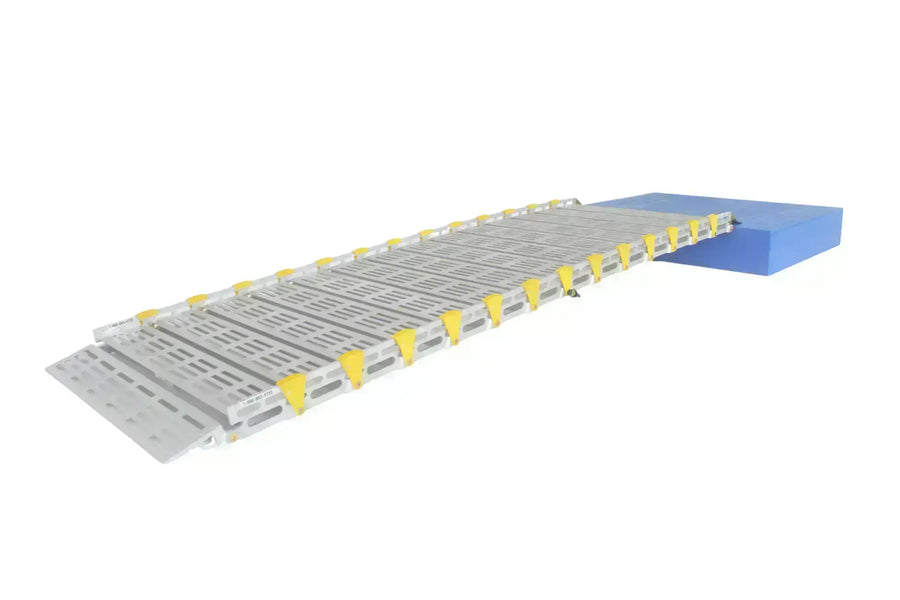
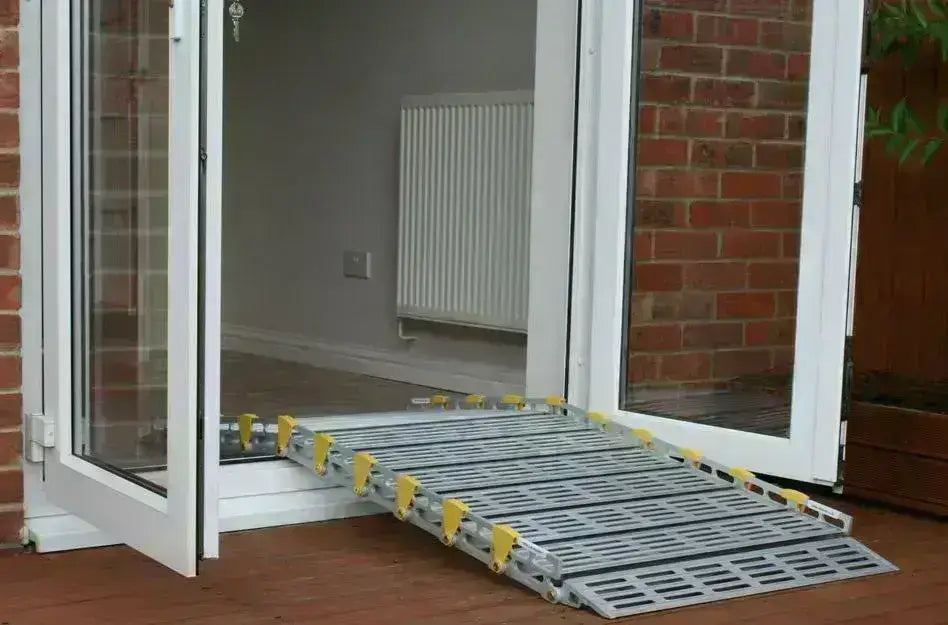
| Portable folding / suitcase ramp | One to two steps | Travel, visits, temporary access | Narrower, usually no handrails; set up each time |
| Modular aluminum ramp | Several steps and up | Daily use at a home or business; handrails and landings | Higher cost; needs space |
| Vehicle ramp | Van or SUV floor height | Loading wheelchairs and scooters | Usually steeper; check the chair's limits |
| Fiberglass ramp | Varies | Light, rust-free portable use | Check capacity |
| Built wood or concrete | Any | Permanent ramps that match the house | Permits, time, upkeep |
Portable ramps
Fold up for the car or closet. Great for visits and short-term needs.
Shop portableModular ramps
Aluminum sections, landings, and handrails that bolt together, with no concrete.
Shop modularVan & scooter ramps
For loading chairs and scooters into vans, SUVs, and trucks.
Shop vehicleSlope and Length: How Long Should Your Ramp Be?
The ADA's 1:12 slope (1 inch of rise per foot of ramp) is the standard for public buildings and the safest choice for anyone going up on their own. For home and portable ramps, the industry uses steeper slopes in specific situations. Roll-A-Ramp, for example, notes that for a strong manual wheelchair user or someone assisting a manual wheelchair, a 2:12 slope is often recommended, and that a 3:12 slope should only be used when no one is sitting in the chair.
| Rise | 1:12 (independent / ADA) | 2:12 (assisted or power chair) | 3:12 (unoccupied only) |
|---|---|---|---|
| 3" | 3 ft | 1.5 ft | 1 ft |
| 6" | 6 ft | 3 ft | 2 ft |
| 12" | 12 ft | 6 ft | 4 ft |
| 18" | 18 ft | 9 ft | 6 ft |
| 24" | 24 ft | 12 ft | 8 ft |
| 30" | 30 ft | 15 ft | 10 ft |
More detail in our ramp slope chart and ramp length calculator.
Ramp Materials: Which Is Best?
Aluminum
- Light, strong, won't rust
- Most portable and modular ramps
- Low maintenance
Rubber
- Heavy, stays put, quiet
- Great for thresholds
- Often cuttable to width
Fiberglass
- Light and corrosion-free
- Good traction
- Portable options
Wood / concrete
- Custom, permanent
- Needs permits and upkeep
- See building a ramp
Wheelchair Ramp Buying Checklist
- Width: at least the chair's width plus room for hands. 36" clear is the ADA minimum for permanent ramps; portable ramps often run 29"–36". See ramp width.
- Weight capacity: covers the person, the chair, and any helper. Power chairs are heavy.
- Surface: slip-resistant, especially outdoors.
- Side curbs or rails: keep wheels on the ramp; handrails on longer ramps.
- Landings: a level spot at the door and every 30" of rise on permanent ramps.
- Top and bottom transitions: smooth, with no lip to catch casters.
- Storage and weight: for portable ramps, can you lift and carry it?
- Rules: businesses must meet the ADA; homeowners should check local code and HOA rules.
Frequently Asked Questions
How do I choose the right size wheelchair ramp?
Measure the rise from the ground to the top of the step or threshold. At the ADA 1:12 slope, you need 1 foot of ramp for every inch of rise. Then make sure the ramp is wide enough for the chair and rated for the combined weight of the person, chair, and any helper.
What type of wheelchair ramp is best for home use?
For a door sill or small step, a threshold ramp. For one or two steps or temporary needs, a portable ramp. For several steps or daily use, a modular aluminum ramp with handrails and landings.
What is the best slope for a portable wheelchair ramp?
1:12 is safest for anyone going up on their own. Many manufacturers allow 2:12 when a strong assistant is helping or for some power chairs, and 3:12 only for loading an empty chair. Always check the wheelchair or scooter manual.
How long of a ramp do I need for 2 steps?
Two standard steps are about 14 to 15 inches high, so you'd need about 14 to 15 feet of ramp at 1:12, or about 7 to 8 feet at 2:12 with an assistant.
Are portable ramps safe for daily use?
They can be for short rises, but for daily use at the same entrance a modular ramp with handrails is safer and more convenient because it stays set up.
What is the difference between a threshold ramp and a portable ramp?
A threshold ramp is short and stays in place to smooth out a door sill or small rise. A portable ramp is longer, folds for transport, and is used for steps or vehicles.
Do I need handrails on my wheelchair ramp?
Public ramps that rise more than 6 inches need handrails on both sides under the ADA. For home ramps, handrails are strongly recommended on any longer ramp, and your local code may require them.
Not Sure Which Ramp Fits?
Send us the rise and a photo of the spot. We'll recommend the right ramp, free.
Call 888-307-1839Request a Free QuoteSources: U.S. Access Board, Guide to the ADA Standards: Ramps · Roll-A-Ramp, How to Determine Ramp Length · EZ-ACCESS, How to Determine Ramp Size.




I’m looking at several ramps needed to meet my requirements. Two low rises and 5 high steps inside. What might they cost me.
I like the photo you have of a rubber threshold ramp. Should I measure the height of the threshold
My wife can’t get in car seat. I need a portable ramp with flat platform to stand on to assist in vehicle entrance. 3 inch max height.
Need ramp near front door. I’m working on strength to go back to work.
Where can such ramps be purchased and how expensive are they ?
Leave a comment